Please reject Marmadua Wind industrial development
192 Submissions to date
The Queensland State Minister has called for public input on the Marmadua Wind development project. This is your opportunity to voice your opinion and reject this harmful development. Here are the facts:
Project details
Where:
23km east of Tara and 41km south west of Dalby
What:
The proposed Marmadua wind farm is located within the Western Downs Renewable Energy Zone, a landscape that has been targeted by wind companies and now looks set to extinguish the lives of threatened bats, birds and raptors.
If approved, 110 Wind Turbine Generators over 250 metres tall will be installed across a 11,168.36 ha land parcel. Blades are 90 metres long and require specialist transport from Brisbane port. A BESS and associated infrastructure will also be installed. Onsite temporary workers accommodation for up to 300 people will be constructed onsite.
Regulated vegetation totalling 12.14 hectares will be cleared.
Access tracks clearance up to 50 m in width (for construction). The Project area is approximately 11,168.36 ha. The Disturbance Footprint for the Project is approximately 905.4 ha, however landscape will de cleared, degraded and fragmented with edge effects greater than the 905.4ha clearing. Delicate ecosystems will be destroyed.
These threatened bird species are confirmed to live here:
Diamond Firetails, Southern Whiteface and White throated Needletail (Vulnerable). Other threatened or special species likely to live here or move through the habitat include Koalas, Yellow Belly Gliders, Short-beaked echidnas, Golden-tailed gecko, Fork Tailed Swifts and incredibly unique Brigelow Woodland Snail.
WE SAY: The proposed Marmadua wind development should be rejected by the State Government as it clearly undermines environmental interests of the State due to:
- Anticipated deaths to bat, bird, raptor and insect deaths, including threatened migratory species from wind turbine impacts.
- Inadequate proponent ecological surveys that do not *sufficiently* detail the possible existence onsite of the Masked Owl, the Red Goshawk, the Southern Greater Glider. https://wetlandinfo.des.qld.gov.au/wetlands/facts-maps/wildlife/?AreaID=tile-100k-dalby
- The wind development will buttress 3 state forests, in close proximity to 2 other state forests. This is an area host to a remarkable array of birdlife.
- This proposed wind development will destroy this critical habitat:
- Diamond Firetails will lose 892.77 ha of habitat
- Fork Tailed swifts will lose 905.4 ha
- Painted Honeyeaters will lose 2.89 ha
- South Eastern Glossy Black Cockatoos will lose 23.84 ha
- Southern Whitefaces will lose 47.02 ha
- White Throated Needletails will lose 905.4 ha
- Koalas will lose 903.9 ha ( the removal of 42.37 ha of suitable breeding/foraging habitat and 861.53 ha of suitable dispersal habitat)
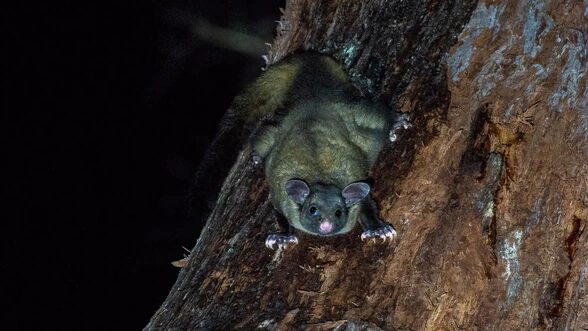
Above: A yellow belly glider, Vulnerable
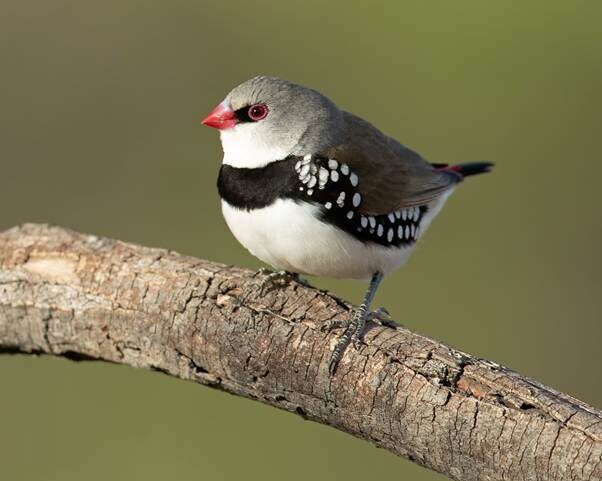
Above: A Diamond Firetail, Vulnerable. Image: By JJ Harrison (https://www.jjharrison.com.au/) – Own work, CC BY-SA 4.0, https://commons.wikimedia.org/w/index.php?curid=83889326
Go deeper
Aerial Impacts
The cumulative impact of so many wind turbines on aerial species, colonising the sky in this region in SE Qld, will lead to gradual depletion of birds, bats and raptors, including threatened species. The proposed Tara wind development (164 wind turbines approx. 37km west) and Cattle Creek development (143 wind turbines approx. 270km south) are in proximity.
Vulnerable White-throated Needletail at risk
Flocks of Vulnerable migratory White throated Needletails were spotted onsite by ecologists. They are prone to dying from turbine strike as they fly at the same height as the wind turbine rotor. They will fly into the path of wind turbines and die. The ecologists consider that the project wont have a significant impact on the White Throated Needletail population but we question why. It’s entirely plausible that flocks could be killed.

By JJ Harrison – Own work, CC BY-SA 4.0, https://commons.wikimedia.org/w/index.php?curid=128875728
Sound ‘footprint’ not considered
This is a vast industrial scale wind farm by any estimation and failure to mention the sound footprint of the operational wind farm is a grave oversight. Impacts of infrasound from spinning turbines on mammals and other wildlife is uncertain and no science has been done in Australia on this. However, it appears from preliminary research conducted by biologist Roger Martin in FNQ that Koala mating calls may be masked by the noise of spinning turbines and that the noise of wind turbines in general may repel them from an area.
Threatened species impacts not sufficiently considered
Although the ecologists mention Greater Gliders as possibly inhabiting tree hollows, they are not explicitly mentioned as potentially inhabiting the site. Why? The true impacts of this wind development have not been accounted for and threatened species may have been inadequately catalogued by the proponent. The full list of threatened species that may occur onsite is hidden at the back of the ecological report at page 128.
Survey efforts inadequate
“Access to some areas of the Project, especially during the high rainfall periods experienced in April 2024, was limited and made it difficult to assess certain parts of the Project area” according to the ecologists. (p.23 MNES report). Its possible other threatened species inhabit the area, but remain unaccounted for by ecologists. Difficult to access areas will remain unaccounted for. This is unacceptable as we are not sure what is really at stake.
Cumulative impacts not duly considered
Aerial impact of 110 turbines in an energy zone already slated for more vast wind farms will be considerable. Birds, raptors and bats will be regularly killed.
Bats, our remarkable pollinators, will undoubtedly die in high numbers
Bats hold their own significant place in our ecosystem. They are key pollinators and control insect populations. They will likely be killed by the hundreds, if not thousands by the wind turbines. They can die horrific deaths from turbine strike or barotrauma. See what we discovered at Kaban wind farm in FNQ here: https://youtu.be/MYI1uchuQtg?si=p3YtRzkSEtJNzldq
We are extremely concerned that even species that are not technically threatened will become so once this wind farm, and the other industrial scale wind farms in proximity become operational. The impact to avian life overall is an alarming prospect and once the turbines commence spinning, damage will be very difficult to reverse.
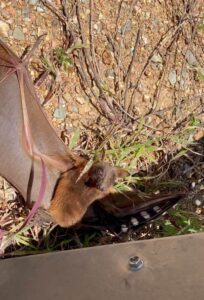
Above: Injured Little Red Flying Fox found underneath a turbine at Kaban wind farm FNQ. Due to the horrific extent of its injuries it had to be euthanised.
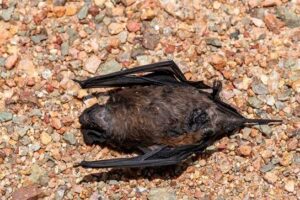
Above: dead Northern Freetail bat found underneath a turbine at Kaban wind farm.
Set to be installed between numerous State Forests
Wildlife moving between the forests will be disrupted and birdlife and bat life killed by the wind turbines. Yellow Belly Gliders will lose connectivity with trees being destroyed. They need to be able to glide between trees. Moving on the ground will expose them to predators. Populations of gliders may be siloed in small clusters of vegetation, unable to move to habitat further afield. This is disastrous for the species and will impact feeding and breeding cycles, impacting the overall local population.
Important threatened species habitat will be destroyed
The land parcel and project area contains important microhabitats that support threatened wildlife including tree hollows, logs, leaf litter and debris, rocks, standing water, burrows and rock crevices. Tree hollows are now endangered all throughout Australia because of bushfires and land clearing. Tree hollows only occur within mature trees at least 80 years old. They provide shelter to Yellow Belly Gliders and other possums and gliders, parrot species, owls and other wildlife seeking refuge. The proponent pledges to replace every destroyed tree hollow with a Glider Box: we say this is a. unrealistic b. will not be independently audited, c. where will the Glider Boxes be installed? The remaining landscape is already host to wildlife and is already “inhabited”. Tree hollows are homes, and destroying a home and replacing it with a nest box nearby does not mean a now homeless and traumatised Yellow Belly Glider family will find it. Wildlife do not cope well with habitat disruption or translocation. It all spells death, slowly or quickly, for reliant species, but this will occur ‘out of sight and out of mind’.